The short answer
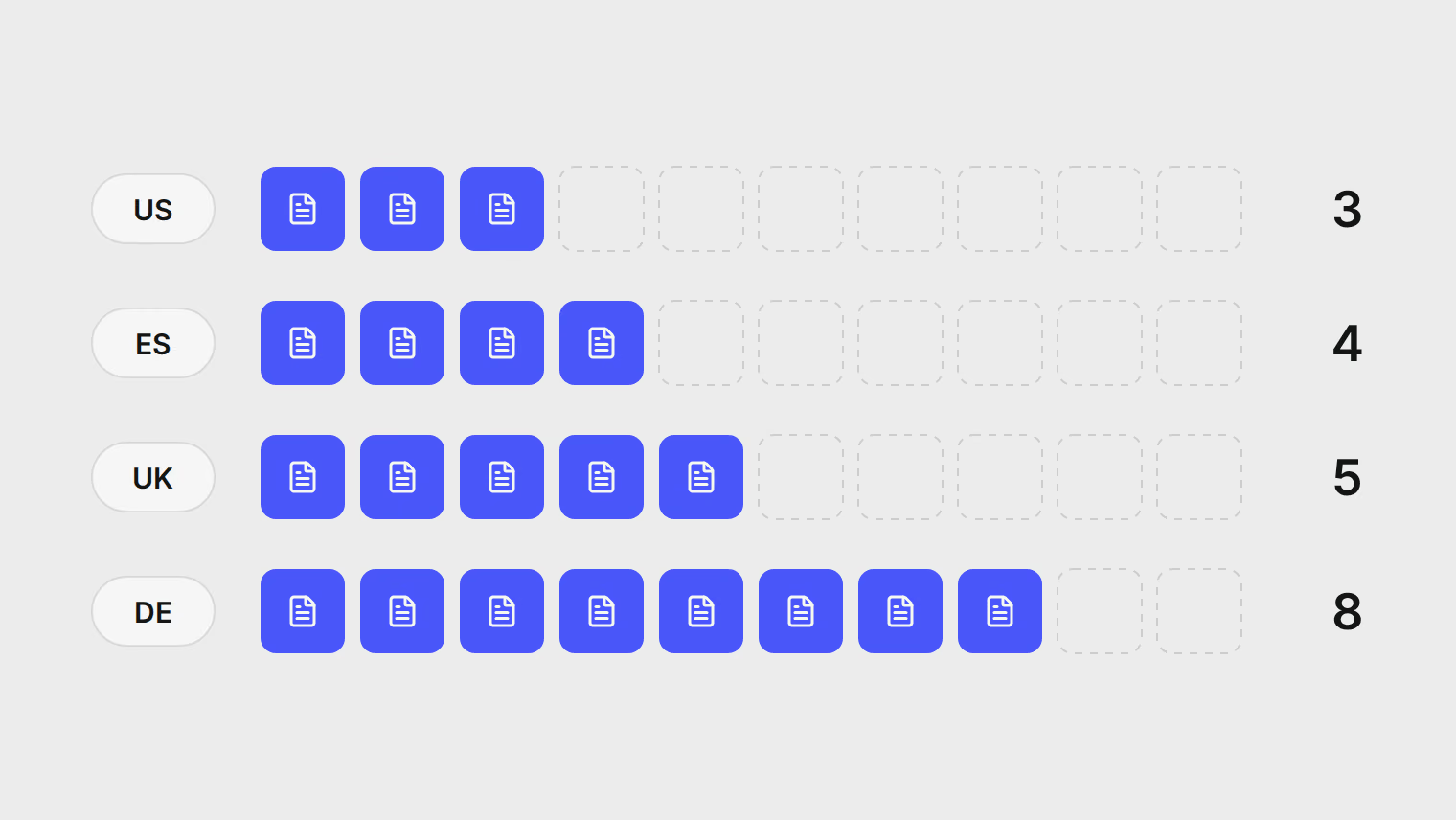
There is no single number. A bank statement is a supporting record: it backs up figures on a tax return, so you keep it for as long as the tax authority can still question that return. That is roughly three years in the US, 22 months to five years in the UK depending on whether you are self-employed, four years in Spain, and eight years in Germany for statements kept as booking vouchers by people who must keep business records.
This is a summary of published rules, not legal or tax advice. Check with a tax adviser before you rely on a date, and especially before you throw anything away.
The rules, from the source
| Country | Who | How long | Counted from |
|---|---|---|---|
| US | Anyone filing a federal income tax return | 3 years, longer in the cases below | The date you filed, or the due date if you filed early |
| UK | Self Assessment filers who are not self-employed | At least 22 months; 15 months after you sent it if the return was late | The end of the tax year the return is for |
| UK | Self-employed | At least 5 years | The 31 January submission deadline for that tax year |
| Spain | Anyone who files a return | 4 years, the period in which the tax agency can assess the tax | The day after the filing deadline |
| Spain | Businesses (empresarios), under commercial law | 6 years | The last entry in the books |
| Germany | Anyone obliged to keep books or records | 8 years for booking vouchers, 6 for other tax-relevant documents | The end of the calendar year the document was created in |
| Germany | Anyone obliged to keep books or records | 10 years for the books themselves | The end of the calendar year of the last entry in the book |
What makes the period longer
The periods above are defaults, and each country has cases that extend them.
United States. The IRS lists the exceptions on the same page as the three-year rule:
- 3 years from filing, or 2 years from paying the tax if that is later, when you claim a credit or refund after filing
- 6 years if you leave out income that you should have reported and it is more than 25% of the gross income on your return
- 7 years if you claim a loss from worthless securities or a bad debt deduction
- indefinitely if you do not file a return, or file a fraudulent one
- for property, until the period runs out for the year you sell or dispose of it, because the records set your gain or loss
United Kingdom. If you send a self-employed return more than four years after the deadline, HMRC asks you to keep the records for 15 months after you send it.
Spain. The four years apply to the tax agency's right to assess, and they are not fixed:
- The period is interrupted by any action of the tax agency you are formally notified of, such as a check or an inspection, by any appeal or claim, and by any step you take towards settling the tax (article 68). Once interrupted, the four years start again.
- The right to check losses carried forward and deductions still being applied lasts ten years (article 66 bis).
- You must be able to back up figures that come from earlier years for as long as the years they affect can still be assessed (article 70).
A statement from 2026 can therefore still be needed long after 2030.
Germany. Section 147 adds a rule that overrides the fixed periods: a document cannot be thrown away while it still matters for a tax whose assessment period has not ended.
Worked dates
Each date below is the earliest the default period can end, assuming the return was filed on time, none of the exceptions above applies, and nothing interrupted or extended the period. Treat it as "keep at least until", not as a date to delete on.
| Case | Example | Keep at least until |
|---|---|---|
| US | Return due on 15 April 2026, filed on time or early | 15 April 2029 |
| UK, not self-employed | HMRC's own example: a 2024 to 2025 return sent online by 31 January 2026 | The end of January 2027 |
| UK, self-employed | 2025 to 2026 tax year, online deadline 31 January 2027 | The end of January 2032 |
| Spain | Filing period ended on 30 June 2026, so the four years start on 1 July 2026 | The end of June 2030, longer if the period was interrupted |
| Germany | Booking voucher from 2026, kept from 31 December 2026 for at least eight years | The end of 2034, longer while it still matters for a tax whose assessment period is open |
In Germany, a book's ten years start only at the end of the year of its last entry.
The same calendar year of statements can reach the end of the default US period in 2029 and still be needed in Germany in 2034.
If the same year's records support returns in two countries, keep them for the longer of the two periods.
Why a statement alone is not always enough
A statement proves that money left your account, on what date, and to whom as the bank describes it. It does not always prove what you bought. The IRS says supporting documents for a purchase should identify the payee, the amount paid, proof of payment, the date, and a description of what was bought, and that "a combination of supporting documents may be needed". Its list of examples includes account statements and credit card statements alongside receipts and invoices.
HMRC's list of records for the self-employed also names bank statements as one type of proof, next to receipts and sales invoices.
So the test is whether your records, together, show each of those elements for the items on your return. A statement may cover some and a receipt or invoice the rest, depending on the item and the rules where you file.
Keep the bank's document, not only your copy of it
The statement your bank issued, usually a PDF, is the record. A CSV export or spreadsheet built from it is your copy of its rows. Keep the original, even if you work from the spreadsheet.
- Format. HMRC says there are no rules on how you keep records: paper, digital, or in software, as long as they are accurate, complete and readable. Germany's section 147 allows most documents to be kept as images or data, but only if this follows the principles of proper bookkeeping, the copy matches the original, and for the whole period it stays available, can be made readable without delay and can be evaluated by machine. A readable image alone does not meet that last condition for records kept as data.
- Your bank's archive is not yours. Online banking lets you download past statements only as far back as the bank keeps them, and a closed account may stop being accessible. Download each statement while you can.
The IRS adds a reminder that applies everywhere: before discarding records you no longer need for tax, check whether you need them for something else. Its examples are insurers and creditors. A mortgage application, a visa or residence permit, or a dispute with a landlord can all ask for older statements.
A simple system
- At each month end, download every account's statement as a PDF, including cards and payment apps.
- Name each file by account and period, such as
current-account-2026-03.pdf, and keep one folder per tax year. - Next to each folder, note the earliest date the default period could end under your rule, using the worked dates above.
- Before removing anything past that date, check the exceptions, whether any inspection, appeal or open claim touches that year, and whether you need the statements for anything else. When in doubt, keep them and ask your adviser.
If you work with an accountant, bank statements for your accountant covers what to send with the statements.
Statements you upload for tracking
Pulget reads the statements you upload and keeps each file linked to the transactions taken from it, so a figure can be traced to its page. Files stay until you delete them.
The workspace export is a JSON file of your data and does not include the statement files themselves. Keep your own copies of the originals.
Before combining several accounts' statements, counting money only once avoids the most common totalling mistakes, and converting statements to CSV covers the spreadsheet side. The pricing page lists the file limits.
Last checked on 18 October 2026 against the IRS, HMRC, BOE and Gesetze im Internet pages linked above. Rules change; check the source before you delete anything.
Sources
Related reading
About the author
Hikmat Samadov, Founder. Hikmat builds Pulget, a spending tracker that reads the bank statements you upload instead of connecting to your bank.