The short answer
Add up what left each account, in that account's currency, for everything the trip paid for: bookings made weeks before, the days away, and charges that arrive after you are home. If an account already paid in your own currency, the amount on the statement is the cost, bank markup included; do not convert it again. Convert only what was paid from a balance in another currency, at a reference rate for the date of each payment. Leave out top-ups and transfers between your own accounts, count cash when you take it out, and subtract what you bring home.
Collect every way you paid
- Before. Flights, trains and accommodation are often booked weeks or months ahead, sometimes on a different card.
- During. Card payments, a multi-currency balance such as Wise or Revolut, and cash from an ATM.
- After. Some card payments post a few days later. A refund, or a deposit you get back, can arrive weeks later.
Take the statement for each account that paid, from the first booking to a couple of weeks after you return. A hotel that blocks an amount on your card at check-in and releases it later usually leaves no transaction at all, so do not count a block you never paid.
Three rules
- What left your account is the cost. If your card is in euros and you paid in pounds, the euro amount on your statement already includes your bank's rate and its conversion fee. Converting the pound price again at a market rate would understate what you paid.
- Convert only foreign-currency accounts, one date at a time. Payments from a pound balance need converting to your currency. Use a published reference rate for each payment's date, such as the European Central Bank's. At weekends and on holidays no rate is published, so use the latest one before the date.
- Leave out your own money moving. Topping up a multi-currency balance from your bank is a transfer, not spending, and so is converting between balances. Counting the top-up and the payments made from it counts the trip twice; combining statements without counting money twice covers this in detail.
A worked example
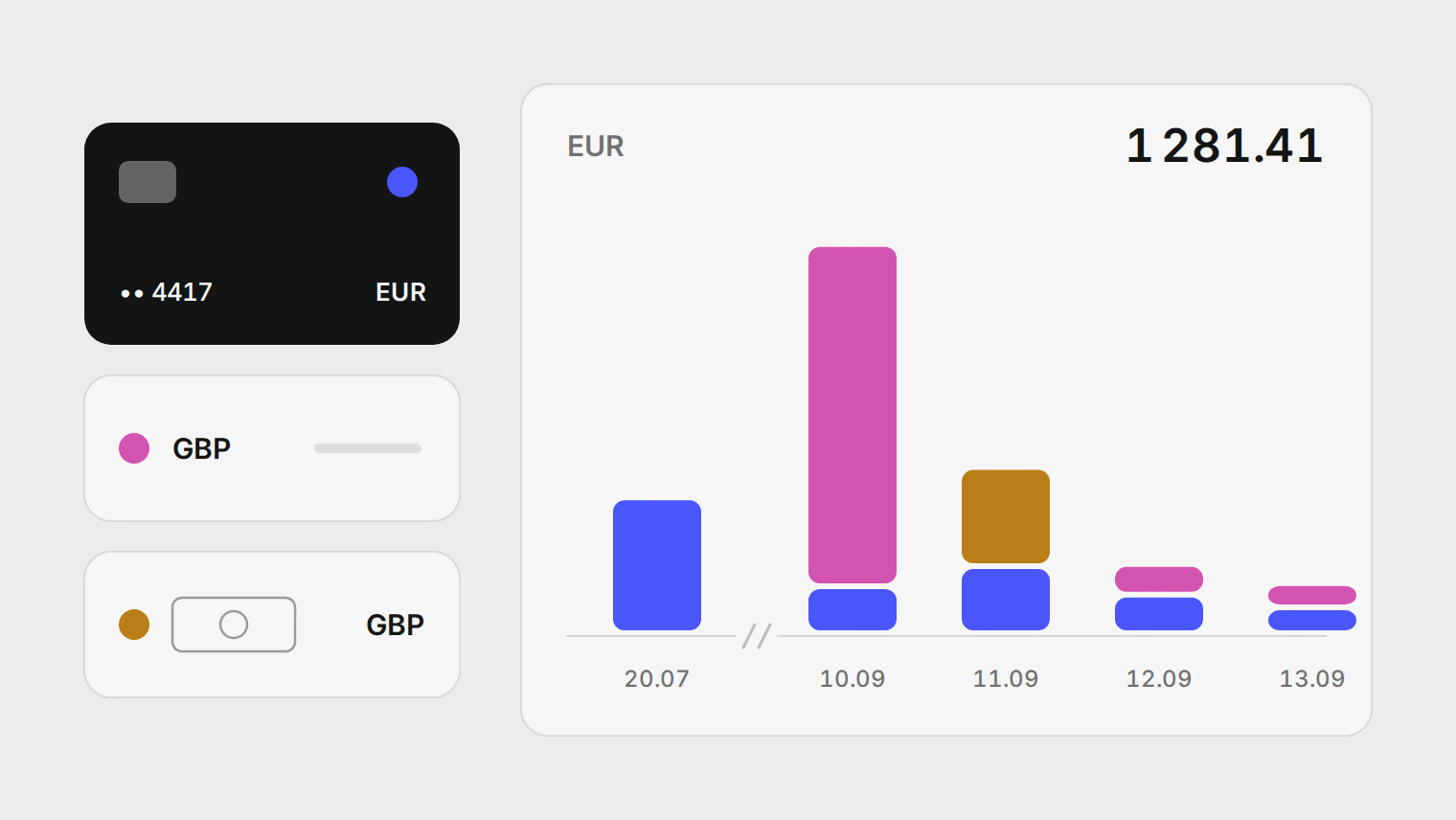
A four-day trip to London, Thursday 10 to Sunday 13 September 2026, by someone who reports in euros. The amounts are an example; the exchange rates are the ECB's published reference rates for those dates. They paid three ways:
- a euro debit card, for the flight, for card payments in London and for one cash withdrawal
- a Wise pound balance, topped up before the trip, for the hotel and some card payments
- pound notes from the ATM
| Date | GBP per EUR |
|---|---|
| Thursday 10 September | 0.85915 |
| Friday 11 September | 0.85815 |
| Saturday 12 September | None (use Friday's 0.85815) |
| Sunday 13 September | None (use Friday's 0.85815) |
| What | Paid from | Original amount | In EUR | How |
|---|---|---|---|---|
| Flight, booked 20 July | Euro card | EUR 214.60 | 214.60 | Already in euros |
| Hotel, paid 10 September | Wise pound balance | GBP 465.00 | 541.23 | 465.00 ÷ 0.85915 |
| Card payments, 10 to 13 Sept | Euro card | GBP 236.80 | 281.96 | As debited by the bank |
| Cash withdrawal, 11 Sept | Euro card at an ATM | GBP 150.00 | 178.05 | As debited by the bank |
| Bank's foreign ATM fee | Euro card | EUR 2.50 | 2.50 | Already in euros |
| Card payments, 12 and 13 Sept | Wise pound balance | GBP 74.50 | 86.81 | 74.50 ÷ 0.85815 (Friday's rate) |
| Cash brought home | Pound notes | GBP 20.00 | −23.74 | 20 ÷ 150 of the 178.05 withdrawn |
| Total | 1,281.41 |
- The Wise top-up made before the trip is not in the table. The hotel and the Wise card payments are, and they are what the top-up paid for.
- The euro card payments count at what the bank debited, EUR 281.96, not at GBP 236.80 converted again.
- The leftover cash is valued at what those notes cost you, not at a market rate. Of GBP 150, the trip used GBP 130; GBP 20 is still in a drawer for next time.
Adding the original amounts as if they were one currency gives 1,216.61, a number in no currency at all. The real cost is EUR 1,281.41.
Where the cost you did not see went
The total already includes the bank's markups and fees, because it is built from what left the accounts. Comparing against the reference rates shows how much of it was conversion cost.
| Payment | At the reference rate | Debited by the bank | Conversion cost |
|---|---|---|---|
| Card payments, GBP 236.80 | 275.86 | 281.96 | 6.10 (2.21% more) |
| Cash withdrawal, GBP 150.00 | 174.79 (Friday's rate) | 178.05, plus a 2.50 fee | 5.76 (1.86% more, plus the bank's fee) |
Card markup. The reference figure converts each day's pound card payments at that day's rate, with Friday's for the weekend. The bank may have converted a day or two after each payment, so treat the 2.21% as an estimate; checking the exchange rate your card charged explains how to check one payment and which date to compare against.
The ATM. Some machines also charge a fee of their own, shown on the screen before you confirm.
If a card machine or ATM offers to charge you in euros instead of pounds, decline. That conversion is done at the machine operator's rate, not your bank's.
The prepaid balance. The hotel is valued here at the reference rate on the day it was paid. The pounds in the Wise balance were bought earlier, at Wise's rate on that day, plus its fee. To value the hotel at what those pounds actually cost you, use the rate from the top-up instead. Either is defensible; pick one and use it for every trip, so trips compare.
Payments from the wrong balance. With a multi-currency card, a payment in a currency you have run out of is converted from another balance. Wise, for example, takes it from the balance with the lowest conversion fee, and you cannot choose which. Check which balance paid before you convert it.
Add up a trip in Pulget
Pulget has Moments for this: a trip, a relocation or another event that you want to see as one cost.
- Upload the statements for every account that paid: your card's account, and one account for each currency balance you used, such as the Wise pound balance. Pulget reads PDF, CSV, XLS, XLSX and DOCX files and does not connect to any bank.
- In Moments, add a moment of the Trip type, with its period and the places you went. The transaction picker lists transactions inside the moment's period, so start the period on the day you booked the first thing, or the flight from July will not be offered.
- Pick the transactions that belong to the trip, from every account. Pulget adds them up in your reporting currency. A payment from a euro account counts at what the account paid. A payment from the pound balance is converted at the published rate for its date, or the closest earlier one, and keeps its original amount. To value it at the rate you actually paid for your pounds, enter that rate on the transaction.
- Read the trip by day, by place and by category. If a transaction has no conversion to your reporting currency yet, the moment leaves it out of the figures and says how many.
For the cash, linking the withdrawal counts all of it, including the notes you bring home. To count only what you spent, add a Cash account in pounds, record the cash payments you remember, and link those instead of the withdrawal. A longer journey can be split into submoments, one per city, which add up to the whole.
A moment records what a trip cost after the fact; it is not a budget you set in advance. The multi-currency guide explains where the published rates come from. For a move rather than a holiday, what your move abroad cost separates the one-off cost from the new monthly baseline. Plans and file limits are on the pricing page.
Last checked on 21 October 2026 against the ECB's reference rates and Wise's card spending help page.
Sources
Related reading
About the author
Hikmat Samadov, Founder. Hikmat builds Pulget, a spending tracker that reads the bank statements you upload instead of connecting to your bank.